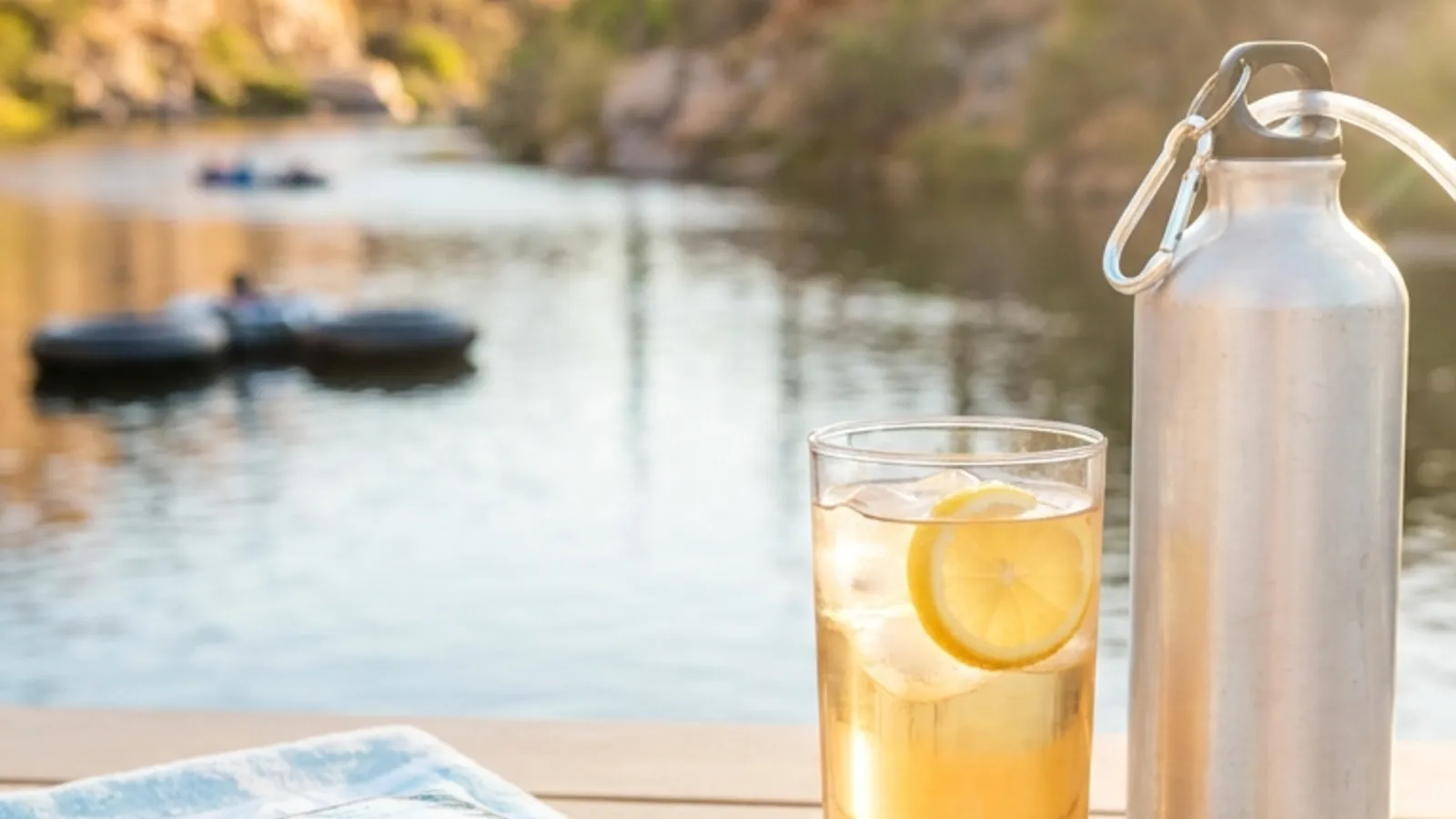
Salt River Tubing Recovery: The Post-Float IV Plan
Salt River tubing recovery is a 30-to-45-minute mobile IV hydration session, ideally pre-booked for the evening of or morning after a 4-to-6-hour float, that replaces the 2 to 5 liters of fluid most adults lose during a Saturday on the Lower Salt River in 105-degree Arizona heat. The protocol bypasses the digestion that is still recovering from beer, sun, and the cooler full of snacks you barely touched, and it gets you functional again before Monday rolls in.
If you parked at the Salt River Tubing lot off Bush Highway at 10am, climbed into a tube on the first put-in, drifted through Tonto National Forest for the next four hours surrounded by a beer-cooler armada, and pulled into your East Valley driveway by 6pm sunburned and confused about whether you ate lunch, this guide is for you. Below: why tubing dehydrates you even though you spent the day half-submerged, the fluid math nobody runs before they head out, how tubing recovery differs from a Lake Pleasant boat day or a backyard pool day, and the pre-booking strategy that keeps Sunday and Monday survivable.
One note up front: RevivaGo does not deliver IVs at the Salt River. Our East Valley service area runs Queen Creek, Gilbert, Mesa, San Tan Valley, Apache Junction, Higley, and Chandler. The recovery IV is what waits for you when you get back to the East Valley side of the Salt River map.
Why Salt River tubing dehydrates you even while you are in the water
Tubing feels like the safest hydration scenario possible. You are touching water for six straight hours. The dry heat does not register the way it does on a boat deck. The reality is the opposite: tubing is one of the most efficient ways to get behind on fluids in Arizona summer because every signal your body uses to tell you to drink is masked. Six mechanisms stack up.
Constant water contact masks heat sensation. Your skin is cool. Your core is working harder than you think to maintain temperature, but the sweat that does form runs straight into the river. You do not feel hot, so you do not feel thirsty. By 2pm, you are operating on autopilot without any of the warning signs.
Beer is the cultural drink of the Salt River. A typical 4-hour float involves 4 to 6 beers per adult, sometimes more on holiday weekends. Beer is a net diuretic with zero electrolyte content. Every can you drink moves you further into the negative.
Reflected UV from the water multiplies sun exposure. According to EPA data on UV reflection from water surfaces, open water adds 10 to 30 percent to the UV your face and chest receive. Sunscreen washes off in the first hour. Most tubing parties end up with significant sunburn that they did not expect.
Air temperature 100 to 105°F with sustained activity. Even sitting in a tube, your body is steering, paddling, repositioning, and reaching for the next beer. The metabolic load over six hours adds up. The Centers for Disease Control and Prevention notes that adults can lose 0.8 to 1.4 liters of sweat per hour during intense heat exposure. Tubing falls into "moderate" heat exposure with extended duration.
No accessible bathroom = self-limited drinking. The same dynamic that drives Lake Pleasant boat-day under-drinking applies here. Peeing in the river is technically frowned upon and very public. Many tubers consciously or unconsciously throttle water intake to manage the bathroom math.
The drive home has no AC for the first 30 minutes. Most tubing trips end with the bus ride back to the parking area, which is hot and slow, and then a 30 to 45-minute drive from the Mesa side of the Tonto back to your address. By the time you walk in the door at 6 or 7pm, you have added two more hours of fluid loss with zero replacement.
For more on how Arizona desert air operates as a silent dehydration multiplier even when you do not feel sweaty, see our Arizona heat dehydration symptoms and treatment guide.
The fluid math of a Salt River float
The numbers are less brutal than a Lake Pleasant boat day, but the alcohol overlay is more consistent.
| Float length | Realistic adult fluid loss | Typical intake on the river | Net deficit at exit |
|---|---|---|---|
| 2 hours | 1 to 2 L | 0.5 L water + 2 beers | 0.5 to 1 L behind |
| 4 hours | 2 to 4 L | 1 L water + 3 to 4 beers | 1.5 to 3 L behind |
| 6 hours | 3 to 5 L | 1 to 2 L water + 5 to 6 beers | 2.5 to 4.5 L behind |
Bottom line: a 4-hour Saturday float for a typical adult ends with 1.5 to 3 liters of net fluid debt, before the alcohol diuretic effect or the drive home gets factored in. A 6-hour holiday-weekend float pushes that number above 3 liters routinely. Add the post-float drive home and the AC-dried air at your house, and you are usually 3 to 4 liters down by 8pm.
Salt River tubing recovery vs Lake Pleasant boat day vs pool day
All three recoveries share a core protocol but use slightly different formulas because the underlying loss pattern is different.
| Salt River tubing | Lake Pleasant boat day | Pool day at home | |
|---|---|---|---|
| Cooling during the day | Constant water immersion | Wind plus occasional swim | Indoor breaks possible |
| Sun exposure | Continuous overhead plus water-reflected | Continuous overhead plus water-reflected | Continuous on the deck |
| Alcohol overlay | High consistency (beer is tradition) | High volume (cooler-driven) | Variable |
| Bathroom availability | None | None | Yes |
| Drive home | 30 to 45 min from Mesa | 60 to 75 min from Lake Pleasant | None |
| Typical net deficit | 1.5 to 3 L (4 hours) | 3 to 5 L (8 hours) | 2 to 3 L (6 hours) |
| Recovery time without IV | 24 to 36 hours | 48 to 72 hours | 24 to 48 hours |
Bottom line: tubing is one tier lighter than a Lake Pleasant boat day on raw fluid loss but more consistent on alcohol overlay. The IV protocol shifts slightly toward heavier anti-nausea support because the beer-to-water ratio is almost always the dominant variable. For the boat day version, see our Lake Pleasant recovery IV guide. For pool day specifics, see our pool day recovery IV Arizona guide.
The Salt River tubing recovery protocol
This is the playbook our team shares with patients heading into a planned tubing day.
Before the float (Friday and Saturday morning)
- Front-load hydration 24 hours ahead. 100 to 120 ounces of water with electrolytes the day before. Sodium is the most underrated tubing-prep ingredient.
- Eat a sodium-heavy meal Friday night. Broth, deli meat, pickles, salted snacks. Carb-loading helps too because the metabolic load on the river is real.
- Pre-book the recovery IV. Pick your time window now, not at 7pm Saturday when you walk in the door dehydrated.
- Pack non-glass water bottles. Salt River Tubing rules prohibit glass. Pack a reusable insulated bottle, at least 32 ounces per person, with electrolyte mix.
During the float (Saturday)
- Alternate beer with water 1:1. One can of beer, one tube of electrolyte water. If that ratio sounds aggressive, your math is correct.
- Take a shade break at the halfway point. Most floats include a sandbar or shoreline shade option around the midway pull-out. Use it.
- Eat real food at the halfway point. Not chips. A wrap, a sandwich, or jerky with sodium.
- Reapply sunscreen every 90 minutes. Sunburned skin loses 20 to 30 percent more fluid for the next 48 hours.
After the float (Saturday evening through Monday)
- Pre-load fluids during the drive home. A 32-ounce electrolyte drink in the car cuts the post-drive deficit in half.
- Hit the pre-booked IV. Saturday evening between 7 and 9pm if you booked an evening slot, Sunday morning before 10am if you booked a morning slot.
- Continue electrolytes for 4 hours after the IV. Maintenance, not loading.
- Plan light activity for Sunday. A Salt River day is a real effort. Sunday training should be a recovery session, not a hard ride.
For athletes pairing tubing weekends with training, our pre-workout IV hydration guide covers the front-loading angle, and our same-day mobile IV across the East Valley guide covers the dispatch logistics for evening-of bookings.
What is in a Salt River tubing recovery IV
The protocol our team uses for post-float recovery shifts slightly toward heavier anti-nausea support because the alcohol overlay is almost always the dominant variable.
- 1 liter of normal saline with electrolytes. The foundation. IV fluids restore plasma volume at 100 percent absorption, compared with the 20 to 50 percent absorption rate of oral fluids cited in Cleveland Clinic research.
- B-complex vitamins. Replenishes what extended heat and alcohol stress depleted, supports cellular energy for the recovery window.
- Anti-nausea medication (Zofran). Added by default for tubing-day recovery. Beer plus sun plus dehydration is a reliable nausea combo, and it blocks oral rehydration before the IV can do its job.
- Toradol. For the sun-and-dehydration headache that ibuprofen barely touches. Especially common after sunburn-heavy floats.
- Vitamin C, optional. Addresses the oxidative load from 4 to 6 hours of direct and water-reflected UV exposure.
- Glutathione, optional. A heavier antioxidant load for the sunburned days. Our glutathione IV therapy benefits guide covers the mechanism.
Treatment runs 30 to 45 minutes. Most clients report meaningful improvement during the bag, especially when nausea was blocking oral fluids before the visit. The full visit from booking to feeling human again usually lands inside 90 minutes.
If alcohol was the dominant factor and the visit feels more like hangover recovery than dehydration recovery, the protocol shifts further toward our hangover IV East Valley service approach. The hangover cure that actually works guide covers the protocol differences.
How to handle family tubing days
Family tubing trips are different from adult-only beer floats. The protocol changes for kids and snapbacks for the recovery plan.
Kids 8 and older. Most outfitters allow kids 8 and up. Hydration is the same idea as adults but with bigger volume of water relative to body weight. Pack reusable bottles with diluted electrolyte drink for kids. Frequent shade breaks, regular snacks with sodium, aggressive sunscreen. No IV therapy for kids without clinical indication from a pediatrician.
Kids under 8. Most outfitters do not permit younger kids on the standard floats. Pool day recovery applies. Our pool day recovery IV Arizona guide covers the family hydration carve-out in depth.
Watch for kid-specific dehydration signs. Children show dehydration through irritability, unusual quietness, fewer bathroom breaks, and dry lips before the symptoms adults pay attention to appear. The escalation path for any child showing signs is pediatrician or urgent care, not a wellness IV.
The designated hydration manager. One adult tracks who has had water in the last 30 minutes and who is due for a snack. Sounds dorky on a tubing trip. Works.
When tubing recovery crosses into something serious
Most tubing recoveries are uncomfortable but not dangerous. A few signals deserve a clear escalation, not a wellness IV.
Skip the recovery IV and route to urgent care or 911 if:
- Body temperature reaches 104°F or higher
- Confusion, slurred speech, or trouble standing
- Persistent vomiting that cannot keep down even ice chips
- Sunburn covering more than 20 percent of skin with severe blistering
- Heart rate sustained above 120 bpm at rest after an hour of cooling
- Severe abdominal pain
- Any signs of heat stroke per our heat exhaustion treatment at home guide escalation criteria
The recovery IV is for the moderate end of post-float depletion. Severe heat illness needs a hospital, not a mobile visit.
Frequently asked questions
What is the best IV for Salt River tubing recovery?
The best Salt River tubing recovery IV starts with 1 liter of saline with electrolytes, B-complex vitamins, anti-nausea medication (Zofran), and Toradol for the sun-and-dehydration headache. Vitamin C and optional glutathione address the oxidative load from extended UV exposure. The Basic Hydration IV at $149 covers the core component, and the tubing-specific extras are add-ons priced at booking. Your clinician adjusts the formula based on your specific symptoms during the medical intake.
When should I book the recovery IV?
Before the float, not after. Saturday evening between 7 and 9pm is the busiest dispatch window of the week for mobile IV across the East Valley in summer, and tubing days reliably stack into that window. Pre-booking your evening-of or morning-after slot at the time you plan the trip locks in the time window and avoids bidding against everyone else who just got home dehydrated. Same-day availability is usually open but the prime evening slots fill fast on holiday weekends.
How is Salt River tubing recovery different from a hangover?
A tubing recovery IV addresses combined dehydration from sun, water exposure, and 4 to 6 hours of physical and metabolic stress, alongside the alcohol overlay. A pure hangover IV focuses primarily on the alcohol metabolites and nausea, with a smaller hydration component. Tubing recovery uses a similar ingredient stack but emphasizes the saline volume and the UV-related additions (vitamin C, optional glutathione). Most tubing patients fall somewhere on the spectrum between dehydration and hangover, and your clinician adjusts the protocol accordingly.
Can I bring water on the Salt River tubing run?
Yes. Salt River Tubing rules prohibit glass containers but allow plastic or aluminum reusable bottles. The most effective tubing prep is an insulated 32-ounce bottle per adult, filled with water and an electrolyte mix, secured to your tube with a carabiner or floating rope. Coolers attached to floats are allowed but get heavy. The reusable bottle is the simpler hydration system for most floats.
How much does a tubing recovery IV cost in the East Valley?
The RevivaGo Basic Hydration IV starts at $149 with no travel fees inside the East Valley service area. If nausea is part of the picture, Nausea Relief at $179 already includes anti-nausea medication, and a B12 shot adds $25. Toradol and other add-ons are priced at booking. The visit is HSA and FSA eligible for many clients. We do not bill insurance. For a fuller out-of-pocket comparison versus urgent care and ER pricing on similar treatments, see our IV therapy cost without insurance guide.
Is Salt River tubing recovery the same as a Lake Pleasant boat day recovery?
The protocols are close cousins but not identical. Tubing tends to involve smaller total fluid loss (1.5 to 3 liters for a 4-hour float versus 3 to 5 liters for an 8-hour boat day) but a more consistent alcohol overlay. The IV ingredients overlap heavily, with tubing leaning slightly toward heavier anti-nausea support and boat-day leaning slightly toward heavier hydration volume. For the boat-day version, see our Lake Pleasant recovery IV guide.
Save Sunday before you lose it
A Salt River float is one of the best summer rituals in the East Valley. A planned Salt River tubing recovery IV is what keeps it from costing you Sunday and Monday. Book the IV when you book the float, drink during the drive home from Mesa, and meet your clinician at your door instead of meeting Sunday at half capacity.
A RevivaGo clinician can be at your Queen Creek, Gilbert, San Tan Valley, or Mesa door in about 30 to 45 minutes. Book a tubing recovery IV before your next float, or explore the full service menu to plan ahead for the rest of summer.
RevivaGo proudly serves Queen Creek, Gilbert, San Tan Valley, and the greater East Valley area. All treatments are administered by licensed healthcare professionals under physician oversight. This article is educational and not medical advice. For severe heat illness, sustained vomiting, signs of heat stroke, or pediatric heat illness symptoms, contact urgent care, your pediatrician, or 911 instead of a mobile IV.