Javelina Jundred Recovery: Your East Valley Post-Race Plan
The 2026 Javelina Jundred starts Saturday, October 31, at McDowell Mountain Regional Park, and the last 100-mile runners have until noon Sunday to finish. After 24 to 30 hours on exposed desert singletrack, most runners are down fluid, down sodium, and too tired to drive anywhere. Good Javelina Jundred recovery starts at the finish line, not on Monday. This guide covers race-week weather, how much you likely sweat, the hyponatremia signs that mean the medical tent instead of an IV, and a day-by-day plan for the week after.
Quick answer: drink to thirst during the race, get checked at the medical tent if anything feels off, and wait until you can eat, keep fluids down, and urinate normally before you book a post-race IV. Never get an IV before or during the race.
Javelina Jundred 2026: dates, course, and race-week weather
Aravaipa Running hosts this looped trail ultra at the Four Peaks Staging Area north of Fountain Hills. Here is the 2026 schedule from the official race page.
| Event | Start | Distance and course | Time limit |
|---|---|---|---|
| 100 Mile | Sat, Oct 31, 6:00 or 6:30 a.m. wave | One 22.3-mile loop plus four 19.45-mile loops, about 6,300 ft of climbing | 30 hours (noon or 12:30 p.m. Sunday) |
| 100K | Sat, Oct 31, 7:00 a.m. | One 22.3-mile loop plus two 19.45-mile loops | 29 hours (noon Sunday) |
| Jackass 31K | Sat, Oct 31, 5:30 p.m. | One night loop | 8.5 hours |
Aravaipa lists average late-October highs near 82°F and lows near 58°F. Past editions have hit the mid-90s by afternoon and dropped into the high 30s overnight. The course has almost no shade. You sweat hard in the afternoon sun, then get cold after sunset and stop feeling thirsty, so fluid balance drifts in both directions.
It is also Halloween weekend, and Javelina is famous for costumes and the party at Jeadquarters. If your crew is celebrating while you run, our Halloween recovery guide covers their Sunday.
Looking for IRONMAN Arizona 2026?
In September 2025, IRONMAN told KJZZ that the November 16, 2025 race at Tempe Town Lake would be the last one held in Tempe, citing growth and construction along the bike course. No 2026 host city had been named. If you are an IRONMAN athlete, the anti-doping IV rule and the post-race plan below still apply to you.
How much fluid and sodium does a 100-mile ultra cost you?
Endurance runners commonly sweat 0.5 to 2 liters per hour, according to the American College of Sports Medicine position stand on exercise and fluid replacement (Sawka et al., 2007). The same paper puts average sweat sodium around 35 mmol per liter, with a normal range of roughly 10 to 70. Your own number depends on size, pace, heat, and genetics.
Here is what that range looks like over a Javelina-length day. These are estimates for illustration, not a prescription.
| Scenario | Sweat rate | Hours moving | Estimated sweat loss | Estimated sodium loss |
|---|---|---|---|---|
| Cool night loops, easy pace | 0.5 L/hr | 10 | 5 L | about 4,000 mg |
| Warm afternoon loops | 1.0 L/hr | 12 | 12 L | about 9,700 mg |
| Hot year, salty sweater | 1.5 L/hr | 8 | 12 L | about 12,000 mg or more |
Bottom line: a 100-mile finisher can lose 15 liters or more of sweat. The risk is replacing it badly, too little or too much, which is why Javelina Jundred recovery begins with a sodium question, not a fluid one.
Hyponatremia warning signs: when you need the medical tent, not an IV
Exercise-associated hyponatremia (EAH) is a blood sodium level below 135 mmol/L during or up to 24 hours after exercise. The main cause is drinking more fluid than you lose, not simply sweating out salt. That definition and the advice to drink to thirst come from the Third International Exercise-Associated Hyponatremia Consensus Statement (Hew-Butler et al., Clinical Journal of Sport Medicine, 2015).
It is not rare in 100-mile races. In five years of data from northern California 161-km races, Hoffman and colleagues found EAH in 15.1% of finishers tested, ranging from 4.6% to 51% depending on the year, and the rate rose with hotter conditions (Medicine & Science in Sports & Exercise, 2013).
Go to the race medical tent, call 911, or head to an emergency room if you notice:
- A headache that keeps getting worse after you stop running.
- Nausea or repeated vomiting, especially if you have been drinking a lot.
- Swollen hands or feet, tight rings, or weighing more than you did at check-in.
- Confusion, odd behavior, or extreme drowsiness.
- A seizure, fainting, or trouble breathing.
- Cola-colored urine, or no urine for many hours, which can point to rhabdomyolysis or kidney strain.
Most IV marketing skips this part. The Wilderness Medical Society's 2019 EAH guidelines say isotonic and hypotonic IV fluids should be avoided in EAH, recommend a point-of-care sodium test for symptomatic athletes, and treat severe cases with 100 mL boluses of hypertonic saline in a medical setting. A standard saline hydration bag at home is the wrong tool for that runner. Our medical intake asks about these symptoms before anyone is dispatched, and if your answers point to the ER, we will tell you so.
WADA's 100 mL rule: post-race only, never before or during
The World Anti-Doping Agency prohibited list (method M2.2) bans IV infusions or injections of more than 100 mL in any 12-hour period, at all times, without a Therapeutic Use Exemption. Hospital care is the exception. USADA applies the same rule, and IRONMAN has sanctioned an age-group world champion who received IV infusions at a clinic. Plain saline counts.
Javelina's 100-mile race is a Western States Golden Ticket race, so front-runners may be in a testing pool. If you are subject to anti-doping rules, talk to your federation before any infusion. For everyone else: no IV the day before, none at an aid station, and none until you are done. Our article on pre-workout IV hydration and WADA explains why pre-race drips are a bad idea for racers.
Your Javelina Jundred recovery plan, day by day
Treat this timeline as a starting point. If anything in the warning list above shows up, stop and get evaluated.
- Finish line (hour 0 to 2). Check in with medical if you feel off. Eat real food with salt, sip to thirst, and sit down somewhere warm. Do not chug water.
- First sleep (hours 2 to 8). Get a ride home or to your hotel. Sleep before you do anything else. Skip ibuprofen and naproxen today, since NSAIDs add kidney strain after ultra efforts.
- Sunday afternoon or evening (hours 6 to 12). This is the usual window for a post-race IV, once you have urinated normally, kept food down, and your head is clear. A provider comes to you, so nobody has to drive.
- Day 1, Monday. Walk a little. Keep eating salty, protein-rich meals and drink to thirst. Expect swollen ankles and quads that hate stairs.
- Days 2 and 3. Soreness usually peaks here. Easy walking, mobility work, and early bedtimes. Monday or Tuesday also works for an IV.
- Days 4 to 7. Short, easy shakeout runs only if walking feels normal. No speed work.
- Weeks 2 and 3. Return to training gradually. Many ultrarunners wait two to four weeks before any hard workout, and a first 100 often takes longer.
Which post-race IV fits after an ultra?
Two RevivaGo treatments fit a Javelina weekend. Both are given by licensed RNs, NPs, or paramedics, and our medical director, Michael Johnson, NP, oversees every order.
| Option | What is in it | Price | Best for |
|---|---|---|---|
| Hydration Boost | 1 liter of normal saline with electrolytes | $149 | 100K and 31K finishers, or anyone who feels dry, headachy, and flat |
| Athletic Recovery IV | 1 liter of saline plus glutathione, B12, B-complex, magnesium, and taurine | $229 | 100-mile finishers with cramping, deep soreness, and fatigue |
| Oral fluids and salty food | Whatever you can keep down | Varies | Everyone, before and after any IV |
Bottom line: if you can eat and drink comfortably and your sodium has not been a problem, an IV may help you feel better sooner. It is one part of Javelina Jundred recovery and does not replace food, sleep, or time. Anti-nausea support is available as an add-on and is priced at booking. See the full service menu before you book.
Getting a post-race IV after Javelina in the East Valley
The race sits outside our home service area, so we do not treat at the course or at Jeadquarters. Most runners and crews stay in the East Valley anyway, and that is where we come to you. RevivaGo visits homes, hotels, and Airbnbs in Mesa, Gilbert, Chandler, Queen Creek, San Tan Valley, and Apache Junction.
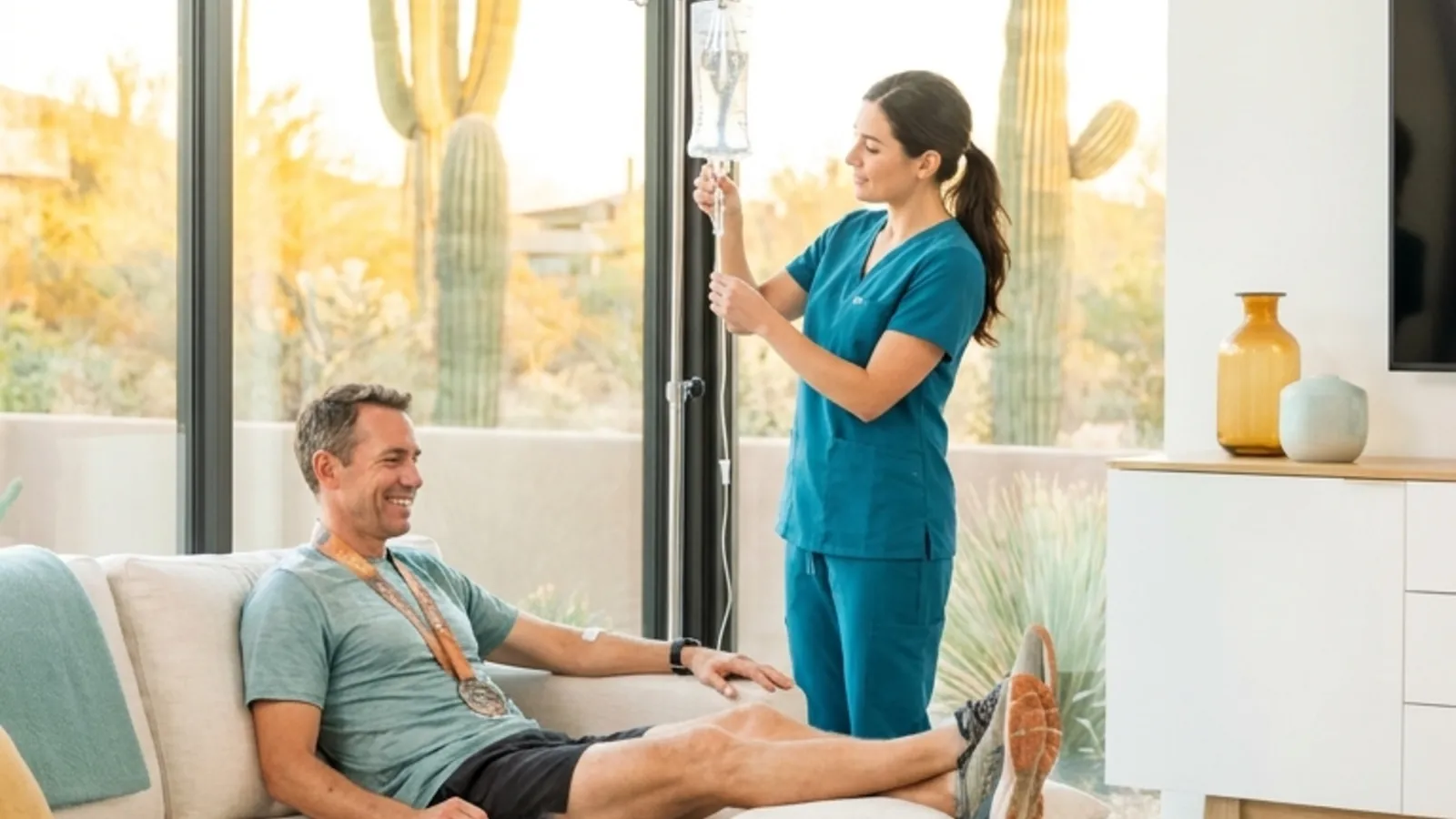
You book online, complete a short medical intake, and a licensed provider typically arrives within about 30 to 45 minutes. The infusion takes another 30 to 45 minutes while you lie on the couch with your legs up. There is no travel fee inside our service area, and group visits work if your crew shares a rental. Sunday evening slots can fill up, so book your Javelina Jundred recovery visit before you leave for the start line.
How soon after the Javelina Jundred can I get an IV?
Most runners do best waiting until they have slept, eaten, and urinated normally, which is often 6 to 12 hours after finishing. For Javelina Jundred recovery, booking Sunday evening or Monday is common. If you have a worsening headache, vomiting, confusion, or swelling, get your sodium checked at a medical facility instead of booking an IV.
Is an IV safe if I might have hyponatremia?
No, not at home. Suspected exercise-associated hyponatremia needs a blood sodium test and medical care, because ordinary IV fluids can lower sodium further. Our intake screens for these symptoms and will direct you to the emergency room instead of sending a provider.
Can I get an IV the day before the race to start hydrated?
We do not recommend it. WADA and USADA rules cap infusions at 100 mL in 12 hours without an exemption, and pre-race fluid loading has little proven benefit. Drink normally in the days before and save IV support for after you finish.
How much does a post-ultramarathon IV cost?
RevivaGo's Hydration Boost is $149 and the Athletic Recovery IV is $229, with no travel fee inside our East Valley service area. Add-ons are priced at booking, and many treatments are HSA and FSA eligible. For a broader comparison of Arizona providers, see our mobile IV therapy cost guide.
Is this different from marathon or hiking recovery?
Yes. Overnight running, big temperature swings, and more hours of eating and drinking on course raise the stakes for sodium balance. For road racing, read our marathon recovery IV guide. For training-block recovery, see athletic recovery IV therapy for East Valley athletes, and for shorter desert efforts, our fall hiking recovery plan.
Ready for your Javelina Jundred recovery?
You trained for months to run through the night at McDowell Mountain. Plan your Javelina Jundred recovery the same way: know the warning signs, eat and sleep first, and line up a post-race visit so you are not driving across the Valley on dead legs. Schedule your post-race IV for Sunday evening or Monday, and a licensed provider will come to your door.
This article is for education and is not medical advice. Talk with your doctor about your own health conditions.
RevivaGo proudly serves Queen Creek, Gilbert, San Tan Valley, and the greater East Valley area. All treatments are administered by licensed healthcare professionals under physician oversight.