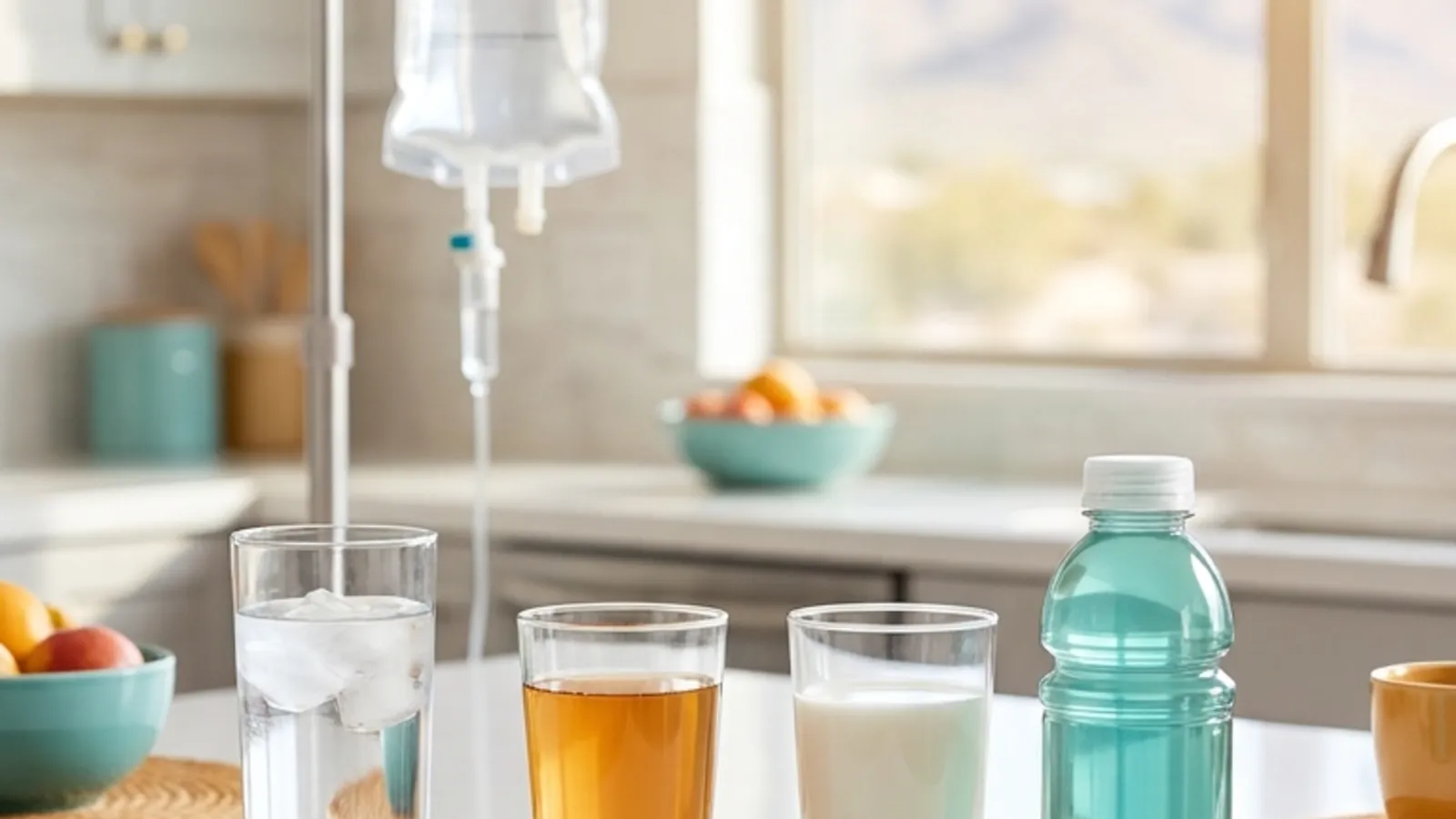
Fastest Way to Rehydrate: 5 Methods Ranked by Speed
The fastest way to rehydrate is IV fluids, because they go straight into your bloodstream and skip digestion. For mild dehydration, though, an oral rehydration solution (ORS) sipped steadily over an hour or two works almost as well for most healthy adults, and it costs a few dollars. Plain water absorbs quickly but tends to pass through you faster than drinks with sodium.
That is the short answer. The longer one matters, because "fast" can mean two different things. One is how quickly fluid reaches your blood. The other is how much of it your body actually keeps. A drink that hits fast and then sends you to the bathroom 40 minutes later is not doing you many favors.
Below, we rank five common options by both measures, using the research our clinical team relies on when we talk with patients across Queen Creek, Gilbert, and Mesa. Desert air pulls water out of you even in November, so this comes up a lot.
This article is general education, not medical advice. If you have confusion, fainting, chest pain, or no urine for many hours, call 911.
The fastest way to rehydrate, ranked
Here is how the main options compare. "Speed" is how quickly fluid reaches circulation. "Retention" is how much stays in your body instead of leaving as urine over the next few hours.
| Rank | Method | Speed into blood | Retention | Best for |
|---|---|---|---|---|
| 1 | IV fluids | Immediate | Very high | Vomiting, moderate dehydration, when oral fluids keep failing |
| 2 | Oral rehydration solution | Fast | High | Mild to moderate dehydration you can drink your way out of |
| 3 | Skim or low-fat milk | Moderate | High | Rehydrating after exercise, if you tolerate dairy |
| 4 | Sports drink | Fast | Similar to water | Long workouts where you also want carbs |
| 5 | Plain water | Fast | Lowest of the five | Everyday thirst and mild fluid loss |
Bottom line: if you can keep fluids down, an ORS is the best mix of speed and staying power for the money. If you can't, or you have already tried for an hour or two without improvement, IV fluids are the quickest route.
Why sodium decides how fast you rehydrate
Your small intestine pulls water in alongside sodium and glucose. A transporter in the gut wall carries sodium and glucose together, and water follows them. That is why the right ratio of salt and sugar can move fluid into your body faster than water alone.
Sodium also helps you hold on to what you drink. When you down a lot of plain water while you are low on salt, your kidneys respond by making more urine. You feel hydrated for a moment, then lose much of it.
So the "fastest" drink is not the one that tastes most refreshing. It is the one that balances absorption with retention. If you want to know what low sodium and potassium feel like, our guide to electrolyte imbalance symptoms covers the warning signs.
1. IV fluids: fastest when your gut is the problem
IV fluids deliver saline and electrolytes directly into a vein. There is no stomach to empty and no intestine to absorb through, so 100% of the fluid is in your circulation as it drips in. A standard 1-liter bag usually runs in 30 to 45 minutes.
That speed matters most when the oral route is broken. Vomiting from a stomach bug, food poisoning, or a rough hangover can make it impossible to keep even small sips down. In those cases, waiting it out often means getting drier.
For otherwise healthy people, research suggests oral rehydration works for most cases of mild to moderate dehydration. A 2006 Cochrane review of 17 trials in children with gastroenteritis found no clinically important difference between oral and IV rehydration overall, though about 1 in 25 children treated orally failed and needed an IV. In other words, the drink usually works, and IV fluids are there for when it does not.
Not sure where you fall? Our article on the signs you need IV fluids sorts symptoms into home care, IV care, and ER.
2. Oral rehydration solution: the best oral option
An oral rehydration solution is a measured mix of water, sodium, potassium, and glucose. The World Health Organization's reduced-osmolarity formula, recommended by WHO and UNICEF since 2002, contains 75 mmol/L of sodium and 75 mmol/L of glucose, with a total osmolarity of 245 mOsm/L.
That lower-concentration recipe was adopted because trials showed it reduced the need for unscheduled IV therapy by 33%, stool output by about 20%, and vomiting by about 30% compared with the older formula, according to the 2002 WHO and UNICEF joint statement.
ORS also did well in a direct beverage comparison. In a 2016 randomized trial published in the American Journal of Clinical Nutrition, Maughan and colleagues gave 72 healthy men 1 liter of 13 different drinks and measured urine output. Two hours later, the ORS had a beverage hydration index of 1.54, meaning the body held on to about 54% more of it than plain water.
To use an ORS well:
- Sip, don't chug. Small, steady sips every few minutes are easier on an upset stomach.
- Aim for a steady pace. Many adults drink 1 to 2 liters over a few hours for mild dehydration, or as directed on the package.
- Check your urine. Pale yellow and more frequent trips usually mean it is working.
Pharmacy ORS packets and ready-to-drink versions both work. We compare popular brands in Liquid IV vs. IV drip, and our piece on oral rehydration salts for a hangover explains how to mix them.
3. Milk: slower to absorb, better at staying put
Milk surprises people. It empties from the stomach more slowly than water because of its protein and fat, so it is not the fastest drink to reach your blood. But it is very good at keeping you hydrated once it gets there.
In the same 2016 Maughan study, skim milk scored a hydration index of 1.58 and full-fat milk scored 1.50, both in the same range as ORS. An earlier 2007 study by Shirreffs, Watson, and Maughan in the British Journal of Nutrition looked at people rehydrating after sweating off fluid during exercise. Over the recovery period, they produced about 611 ml of urine after low-fat milk compared with about 1,184 ml after water. People who drank milk stayed in positive fluid balance, while the water and sports drink groups slipped back into a deficit within an hour.
Milk's natural sodium, potassium, and protein likely explain the difference. It is a solid choice after a hike at San Tan Mountain Regional Park or a hot pickleball session. It is a poor choice if you are nauseated or lactose intolerant.
4. Sports drinks: fine for workouts, not a rescue
Sports drinks contain some sodium and sugar, so they seem like they should beat water. In the Maughan trial, they did not. Cumulative urine output after the sports drink was no different from water at four hours.
The reason is mostly sodium. Typical sports drinks carry far less of it than an ORS, and some have more sugar than is ideal when your stomach is unsettled. They are useful for fueling long workouts in the heat. They are not the quickest way to recover from real dehydration.
5. Water: fast in, fast out
Water absorbs quickly and is perfect for everyday thirst. The trouble is retention. Drink a large amount at once without sodium, and a good share of it leaves as urine within a couple of hours. Coffee, tea, cola, and lager performed about the same as water in the 2016 study, which also means your morning coffee is not dehydrating you.
If water is all you have, sip it with a salty snack. Crackers, pretzels, or broth add the sodium that helps your body keep what you drink.
What to do if you can't keep fluids down
When vomiting or severe nausea stops you from drinking, the fastest way to rehydrate is IV fluids. Try small sips of ORS every five minutes first. If you still cannot hold anything down after an hour or two, or you feel dizzy when you stand, oral rehydration is not keeping up.
That is the situation where a mobile IV makes sense. A licensed RN, NP, or paramedic comes to your home, checks your vital signs, and starts your IV on your couch, with every treatment plan reviewed under physician oversight. Providers often arrive within 30 to 45 minutes of booking. Our IV hydration in Queen Creek page explains what is in the bag, and you can see how long IV hydration lasts afterward.
Go to the ER instead if you notice confusion, fainting, a racing heart at rest, blood in vomit or stool, or no urine at all.
How fast does IV hydration work?
IV hydration works as it drips, because the fluid enters your bloodstream directly. Most people get a 1-liter bag over 30 to 45 minutes. Many clients report feeling less dizzy and less foggy before the bag is finished, though how fast you feel better depends on how dehydrated you were and why.
Is Pedialyte or Liquid IV faster than water?
Pedialyte and similar ORS products may help you rehydrate faster than plain water when you are already dehydrated, because their sodium and glucose speed absorption and reduce urine loss. Some drink mixes have less sodium than a true ORS, so check the label. Look for a product close to the WHO formula if you are rehydrating after illness.
How long does it take to rehydrate by drinking?
Mild dehydration often improves within a few hours of steady drinking with an ORS or water plus salty food. Moderate dehydration can take most of a day by mouth. If symptoms are not improving after a couple of hours of steady sipping, or you cannot keep fluids down, it is time to consider IV fluids or medical care.
What is the fastest way to rehydrate after a hangover?
For a hangover, the fastest way to rehydrate is usually an ORS if your stomach can handle it, sipped slowly with a light salty snack. Alcohol increases urine output, so water alone can feel like it disappears. If nausea or vomiting keeps you from drinking, an in-home IV with fluids and anti-nausea support may help you feel better sooner.
Is drinking a lot of water at once a good way to rehydrate?
No. Chugging large amounts of plain water at once mostly increases urine output, and in rare cases drinking far too much water can drop your blood sodium to unsafe levels. Steady sips of a drink with sodium, spread over an hour or more, work better and are safer.
Rehydrate at home with RevivaGo
Most of the time, an ORS and a little patience are all you need. When they are not enough, we can bring IV fluids to you anywhere in the East Valley. Our Hydration Boost IV starts at $149 with no travel fee and no hidden charges, and the price you see is the price you pay.
You can book an in-home IV in a few minutes or browse our full treatment menu first. Whether you reach for a drink or a drip, the fastest way to rehydrate is the one that matches how dehydrated you are.
RevivaGo proudly serves Queen Creek, Gilbert, San Tan Valley, and the greater East Valley area. All treatments are administered by licensed healthcare professionals under physician oversight.