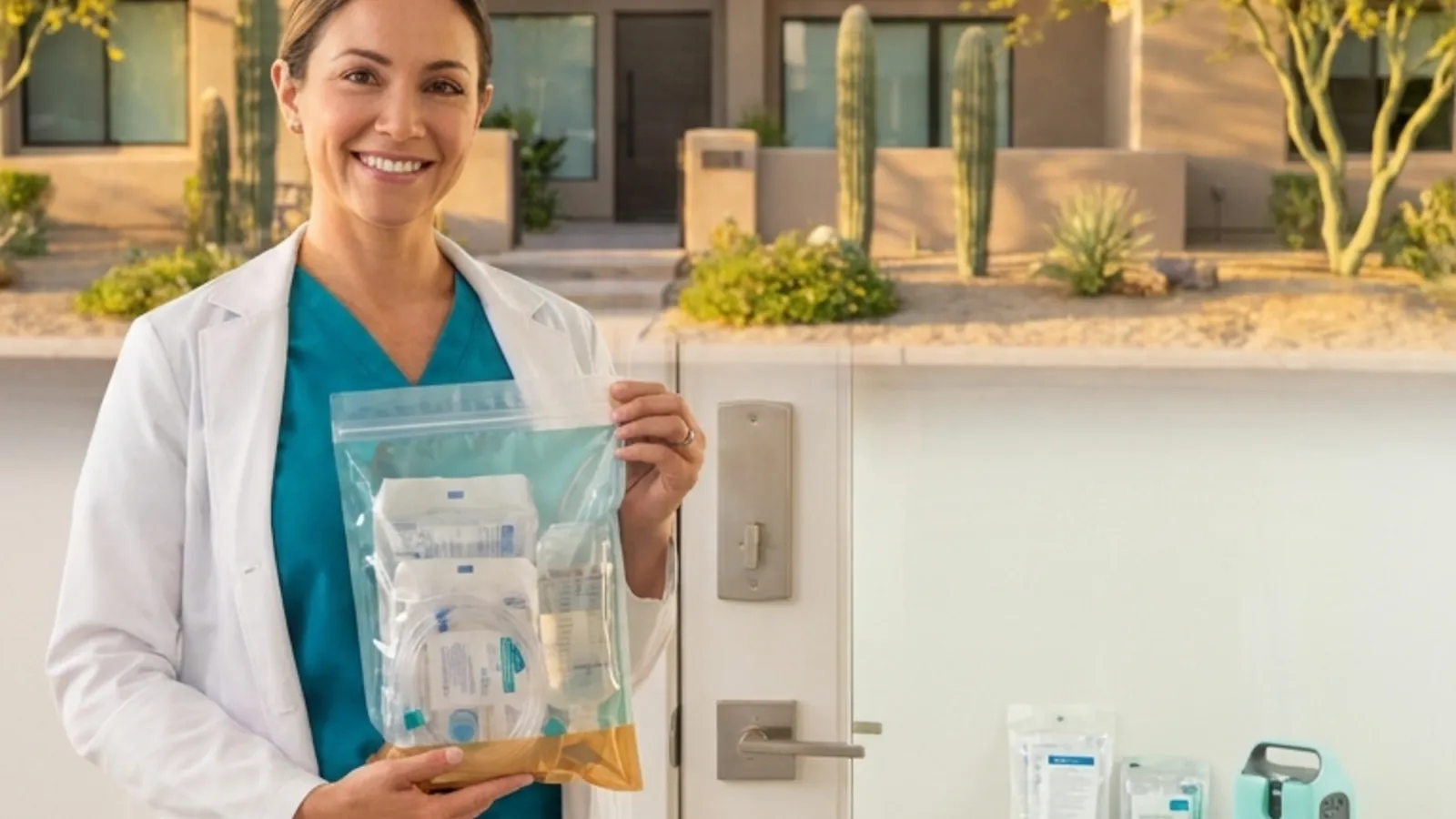
Can I Buy IV Fluids for Home Use? An NP Explains
Can I buy IV fluids for home use? In the United States, not legally without a prescription. Sterile IV solutions like normal saline and lactated Ringer's are prescription drugs, and every legitimate bag carries an "Rx only" label. Pharmacies and medical suppliers will not sell them to you for self-use, and the sellers who skip that step are the ones to worry about.
People ask this for good reasons. Maybe you get dehydrated every Arizona summer, you are a nurse who already knows how to start a line, or you just priced an ER visit and flinched. This guide covers why IV fluids are locked behind a prescription, what you actually get from "no Rx" sites, whether nurses and paramedics can buy their own, and the real risks of a DIY drip.
If you only need fluids today, there is a shorter path. A licensed RN, NP, or paramedic can be at your door in Queen Creek or Gilbert in about 30 to 45 minutes. See treatments and book starting at $149.
Why are IV fluids prescription-only?
IV fluids are prescription-only because they go straight into your bloodstream, with no gut, skin, or liver to filter mistakes. The FDA regulates sterile solutions such as 0.9% sodium chloride injection as prescription drugs, and the manufacturer labels on these bags, including those from B. Braun and Hospira, are marked "Rx only."
That label is not red tape for its own sake. Choosing the right fluid, the right volume, and the right rate depends on your kidneys, your heart, your blood pressure, and your electrolytes. A prescriber is supposed to weigh those before anything runs into a vein. Even the choice between fluids matters, as our comparison of lactated Ringer's vs. normal saline explains.
Can I buy IV fluids for home use online?
You can find listings, but that does not make them legal or safe. A search for IV bags turns up three kinds of sellers, and none of them is a good answer:
- "No Rx required" marketplace listings. Some sites sell saline bags and start kits labeled for "at-home use and pets." Veterinary or unverified products are not held to the same standards, and you have no way to confirm sterility or what is actually in the bag.
- Illegal online pharmacies. According to the National Association of Boards of Pharmacy, about 95% of websites selling prescription drugs online are doing so illegally. Many ship without a valid prescription, which is exactly what makes them risky.
- "IV hydration kits" that are not IVs at all. Most products sold under that name are oral electrolyte powders. They can help mild dehydration, but they are drink mixes. Our breakdown of Liquid IV vs. an IV drip covers the difference.
The FDA's BeSafeRx program warns consumers to buy prescription medicines only from state-licensed pharmacies that require a prescription. A site that happily ships IV bags with no questions asked is telling you something about its standards.
Can nurses buy IV fluids for personal use?
Generally, no. A nursing license lets an RN administer IV fluids under a prescriber's order. It does not let an RN order or buy them for themselves. Medical distributors sell to licensed facilities and practices, not to individual nurses for home use.
Nurse practitioners can prescribe in Arizona, but treating yourself is a different matter. Most professional ethics guidance and many state boards discourage clinicians from prescribing for themselves or family outside of emergencies, because objective judgment is hard when you are the patient. Starting your own IV adds a practical problem too: you cannot safely monitor yourself while the line runs.
The Arizona State Board of Nursing's advisory opinion on IV hydration frames IV hydration as care delivered by licensed nurses with proper medical direction, which is the opposite of a solo setup at the kitchen table.
Can paramedics give IV fluids at home?
Yes, under medical direction. Paramedics start IVs in the field every day, but they do it under protocols set by a supervising physician or medical director, not on their own authority. The same applies at RevivaGo. Our paramedics, RNs, and NPs give IV hydration in your home under physician oversight, with every intake reviewed by our medical team, led by medical director Michael Johnson, NP, before a provider heads your way.
That structure is the whole point. The skill to place a catheter is only half of safe IV care. The other half is a clinical review that asks whether you should get fluids at all.
What can go wrong with a DIY IV at home?
Plenty, and most of it happens fast. These are the main risks clinicians train for:
| Risk | What it is | Why it matters at home |
|---|---|---|
| Infection | Bacteria enter through the insertion site or a contaminated bag | Can range from a sore, red arm to a bloodstream infection |
| Phlebitis | Inflammation of the vein around the catheter | Published studies of hospital catheters report rates from about 5% to as high as 70%, even with trained staff |
| Infiltration | Fluid leaks into tissue instead of the vein | Swelling, pain, and possible tissue damage if no one notices |
| Fluid overload | Too much fluid, too fast | Risky for anyone with heart or kidney issues, and hard to spot alone |
| Air embolism | Air enters the line | Rare, but potentially serious, and the reason priming lines correctly matters |
| Wrong fluid | Unknown or mislabeled product | You cannot verify an unregulated bag's contents or sterility |
Bottom line: a trained clinician watching the line, checking vitals, and stopping the infusion at the first sign of trouble is the main safety feature. A DIY setup removes it. Cleveland Clinic's overview of IV fluids lists many of these same complications. For how we handle them, see our guide to IV therapy side effects and safety.
What should you do instead of buying IV fluids?
Match the route to the reason you want fluids. Here is the short version:
- Mild thirst or a long day outside. Start with water and an oral electrolyte drink. If you can keep fluids down, this is often enough.
- You need IV fluids for a diagnosed condition. Ask your physician about prescribed home infusion. We cover that path in can a doctor prescribe IV fluids at home, and our guide to whether insurance covers IV therapy at home explains billing.
- You want hydration now and feel run down, hot, or hungover. Book a licensed mobile IV provider. Your intake is reviewed, the provider brings sterile single-use supplies, and you stay on your couch.
- You have chest pain, confusion, fainting, or cannot stop vomiting. Skip all of the above and call 911 or go to an emergency room.
Not sure where you fall? Our list of signs you need IV fluids can help you decide.
What does a licensed home IV cost compared with doing it yourself?
A RevivaGo Hydration Boost is $149, with one liter of fluids and electrolytes, the licensed provider, sterile supplies, and travel inside our East Valley service area included. There are no travel fees and no surprise add-on bill at the door.
A DIY setup might look cheaper on a product page, but the price leaves out what you lose: a medical review, a trained hand placing the catheter, and someone watching for problems. If something goes wrong, an ER visit can cost far more than the drip you were trying to avoid.
If you want more than fluids, the full treatment menu includes options like Myers' Cocktail at $199, Nausea Relief at $179, and Hangover Relief at $229.
Is it legal to have IV fluids at home?
Yes, if they are prescribed to you. Patients on home infusion keep prescribed fluids and supplies at home under a physician's order, usually with a home health nurse managing them. What is not legal is buying prescription IV solutions without a valid prescription from a licensed source.
Can I buy saline bags at a pharmacy?
Not for IV use without a prescription. Retail pharmacies sell saline nasal sprays, wound wash, and contact lens solution over the counter, but none of these are sterile IV fluids. Sterile IV bags are dispensed by pharmacies only against a valid prescription.
Can I get IV fluids without seeing a doctor first?
For a wellness IV, you do not need to visit a doctor's office. With RevivaGo, you complete a short health intake, our medical team reviews it under physician oversight, and a licensed provider is dispatched. That review is the step a DIY bag skips.
Is it safe to start your own IV if you are trained?
It is not recommended. Even experienced clinicians cannot reliably monitor their own vitals, catch infiltration, or respond quickly to a reaction while the line runs. Safe IV care depends on a second person watching, which is why hospitals and mobile IV providers never leave a patient alone during an infusion.
Is mobile IV therapy HSA or FSA eligible?
Many treatments are HSA and FSA eligible for qualifying patients, though wellness IVs are rarely covered by insurance. Check with your plan administrator. Our guide to using HSA or FSA for IV therapy explains how it usually works.
Skip the workaround and get fluids the safe way
So, can I buy IV fluids for home use? Not without a prescription, and the online shortcuts carry real risk of contaminated products, wrong fluids, and complications no one is there to catch. The safer route is also the easier one. A licensed RN, NP, or paramedic brings sterile supplies to your door, checks you over, and stays with you for the full 30 to 45 minute drip.
Ready to feel better without the guesswork? Book a Hydration Boost from $149 and a provider can be on the way to Queen Creek, Gilbert, San Tan Valley, or Mesa today.
This article is for educational purposes and is not medical advice. Talk with your healthcare provider about your specific situation.
RevivaGo proudly serves Queen Creek, Gilbert, San Tan Valley, and the greater East Valley area. All treatments are administered by licensed healthcare professionals under physician oversight.